And Then What?
On outrage, pluralism, and the heavy lift of staying in the room

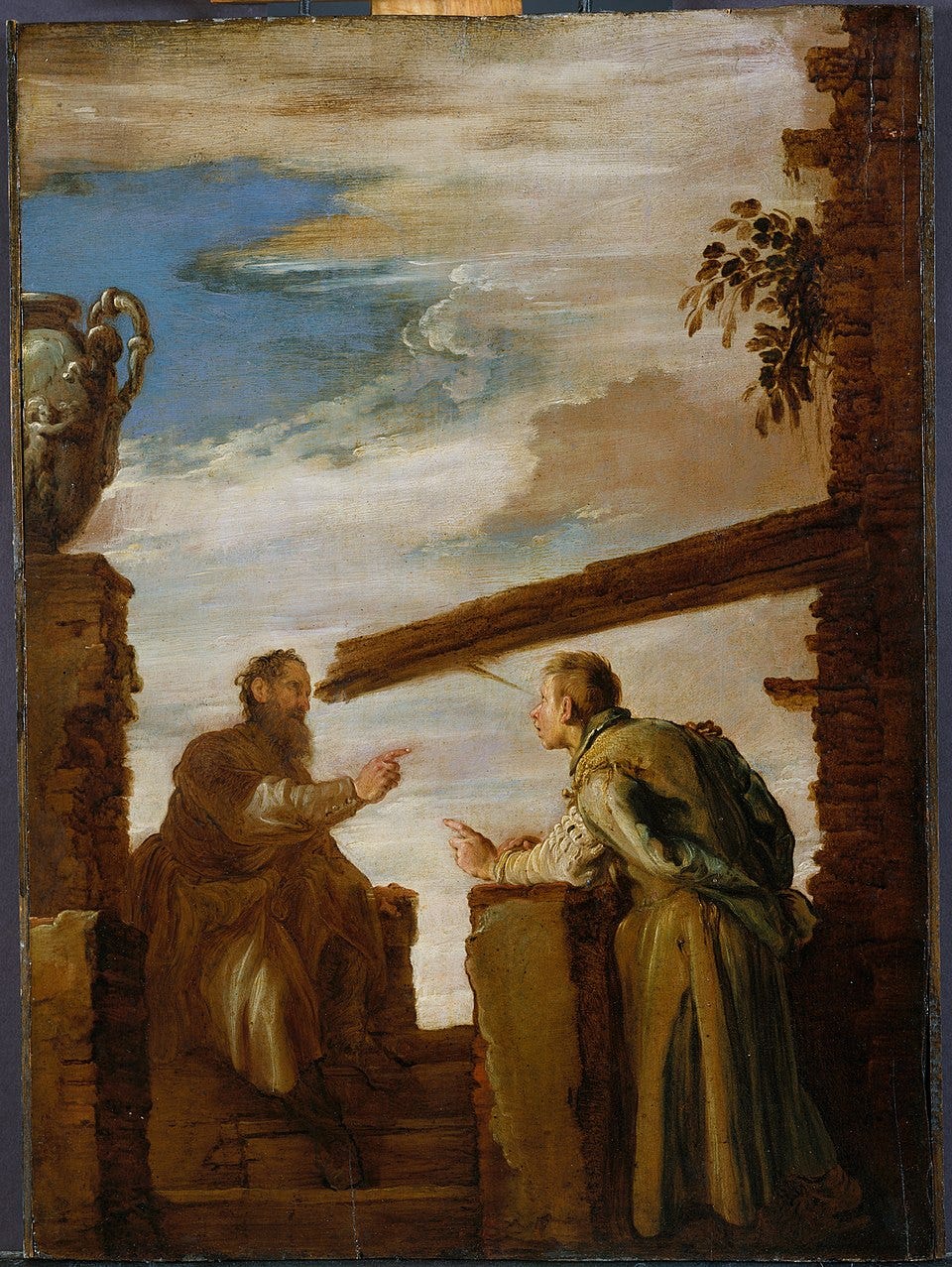
My vicar and friend, Matthew Colwell, was recently teaching on the concept of addressing the “log” in our own eye before pointing out the “speck” in someone else’s. I’ve read through this passage in Scripture and heard it covered in Bible studies many times. But Matt brought out a meaning I hadn’t considered.
A speck is so light as to not even notice it. To point out someone else’s faults and shame them into corrective behavior costs us nothing. A log, on the other hand, is weighty. To lift it requires much greater exertion. The log in our own eye demands that much more mental, emotional, spiritual energy to address.
For those of us who are politically and socially conscious, what so often animates us is the proverbial speck in our brother’s eye. It’s become reflexive to see something someone did, hear what they said, and feel that jolt of negative reaction. “How can they say that?” we ask, with something between incredulity and contempt.
Turns out there’s science behind it. Former Congressman and intelligence officer Denver Riggleman first put this on my radar: the doomscroll, the headline you click knowing it’ll make your blood boil, neurologically that’s closer to a hit than a habit. It follows the same reward pathways as cocaine. Same loop. The brain gets conditioned to seek the stimulation. The outrage isn’t just a feeling. It’s a dependency.
Pop open any of your social media feeds and there’s no shortage of supply. Most nights, the current president provides the world with a bevy of rambling rage tweets. Any given day some elected official somewhere says something or records something for their TikTok feed that’s uncouth, unkind, smug or downright hateful. Yet most of one base will love it while the other base hates it. No shortage of fuel for the affective polarization fires.
And we consume it. All of it. Those of us who are most plugged in are mainlining their preferred content all day every day. Others catch a news show once a week or maybe scroll through a feed for twenty minutes before bed. Even the least engaged can name a symptom or two. Almost everyone, across every level of engagement, believes something is broken. Not just in our politics. In the country itself.
But here’s what’s virtually universal in how people describe the problem: it’s always about “them.” You know, “the other side.” What they are doing. What they said. What they believe. What they’re getting away with. The speck, in other words, is always in someone else’s eye.
All the while: can any of us reckon with the degree to which we are one of them?
There’s a Dr. Seuss book. The Butter Battle Book. The Yooks and the Zooks, at war with each other over which side of the bread to butter. Complaining about each other, raging at each other, arming themselves against each other until the whole thing teetered on mutual destruction. And even the children still learning to read could see what the famous author was getting at. These guys and those guys had more in common than either side could admit.
Now, that’s not to say all sides are equally culpable in every conflict. False equivalence is its own kind of intellectual dishonesty. Some fights are asymmetrical. Some actors are more dangerous than others. But there’s a prior question worth grappling with before we get there: how confident are we in our own self-assessment? Near the end of Falling Down, Michael Douglas’s character is standing there genuinely bewildered, asking, “I’m the bad guy?” He’d told himself a story the whole time in which he was the reasonable one. The Yooks thought the same thing. So did the Zooks.
That’s not equivalence. That’s a wake up call. Or it should be.
So here’s the log. Would any of us be willing to give up the habit, if only temporarily, sit down with one of “them,” rein in the impulse to judge or to contend, and truly hear someone who checked a different box on the last ballot?
Not someone who actively engages in or encourages violence. That’s a different conversation, and frankly, a different institution, one with a gavel and a sentencing guideline. But someone who voted differently? On a ballot measure, for a state legislator, or at the top of the ticket? Yeah. There are millions of those someones. And most of us won’t go there.
The indignation pays. It provides identity, community, and moral clarity. Surrendering it isn’t just humbling. It’s a genuine loss. Which is why it’s heavy.
Are we more addicted to the fight than committed to what the fight is supposed to be about? There’s a difference. Some have become so ingrained in their own contentiousness that the fight itself, not some higher ideal or creed, but constantly being on the offensive against some supposed enemy, is the whole ballgame.
There’s a scene in the last season of The Good Wife that gets at this. Two type-A men, in direct conflict, tension building over many episodes, finally come face to face. Nose to nose, one says to the other: “I should kick your ass.” The other, unfazed, says: “You could try… And then what?”
The aggressor has no answer. Because he never thought past the fight. The fight was the answer. There is no “and then.”
So what would something different even look like? Instead of posting that perfectly crafted dose of snark, raging at Uncle Stan at Grandma’s birthday party, cheering along with our favorite rage merchant of a pundit, nodding along while the blowhard at your Bible study decides to “teach” everyone what’s really going on with “the Left,” are any of us capable of trying something different? Like actually listening to the one we really disagree with. Like remembering that person’s humanity. Like considering not necessarily that we’ll agree on anything, but that we might share something? Like values. Or goals. Or simply that we love this person. These aren’t new civic muscles. They’ve just atrophied. And we have to reclaim them.
Let me give you a couple of examples from my own life. Neither one makes me look particularly good.
A few years ago, one of my kids was hesitant about the COVID vaccine. Not anti-vax. His position was actually more nuanced than that. He felt the whole thing was moving too fast. “Operation Warp Speed” wasn’t exactly reassuring branding for a teenager trying to make sense of the world. He wanted to wait for full FDA approval before he made any decisions. He didn’t want to be a science experiment.
That’s not an unreasonable position. But that’s not what the rest of us heard. What we heard was obstinance. A wrong answer. And we came at him accordingly. I was part of the dogpile.
Predictably, it backfired. He dug in. His thinking, more or less was: to hell with all of you, now I’m definitely not getting the damn shot. And look, I understood the frustration with that kind of truculence. This was a life and death issue. There was urgency. But there were also plenty of people around him, online, in leadership, adults he respected, who were expressing their own versions of vaccine skepticism. He wasn’t living in a vacuum. He was living in the same polarized information environment the rest of us were. He just happened to be on the other side of it from me.
Months later, when things had calmed down, I went back to him. Not to lecture him this time. I had no agenda except to earnestly hear him out. And that’s when I learned what he was actually thinking. We still disagreed. My trust in the scientific process, imperfect as it is, ran considerably deeper than my trust in whatever Fox News or Donald Trump were peddling that week. But I kept most of that to myself. I just listened. I tried to ask honest questions, not interrogatives, but questions that showed my kid I was curious and interested in him. My strong opinions leaked out a couple times, but thankfully he gave me enough grace to stay in the conversation anyway.
He felt heard. That was it. That was the whole thing.
Months after that, when the world opened back up and we were planning a trip to see old friends, he still wouldn’t get the vaccine. But he agreed to get tested. Thankfully, it came back clean. And he came on the trip. That probably doesn’t happen if we never rebuilt the connection. If he’d only ever felt ganged up on, he likely doesn’t agree to the test, doesn’t join us, retreats further into one particular information silo. That’s how it works. That’s how relationships sever and people get more entrenched. Or, clumsily and imperfectly, that’s how you find a way forward. Together.
More recently, a buddy of mine turned out to be a big Pete Hegseth fan. I’ll be blunt about where I land on Hegseth: the man is a toxic combination of incompetence and malice, held together by an epic, unearned level of self-confidence. And that’s not a hot take based on a few bad headlines. These views are shaped by long conversations with people who spent decades in the military, two in particular, a Navy SEAL and a West Point grad, who achieved considerably higher ranks than Hegseth ever did.
My buddy just doesn’t see it that way. He’s a student of history, and in his view, this is how wars are won. Go in, blow a bunch of shit up, and let the diplomats deal with the cleanup. He doesn’t have a problem with what he considers legalistic technicalities. He always circles back to “This is war.” He cheers the chest thumping, the Activision-style operation names, the bombs dropped without Congressional authority. He loves all of it.
For a while, every time we got together we’d butt heads. I’d object to something and he’d start talking to the ceiling: “Oh my GOD! What are you TALKING ABOUT?!?!” We were like two rams going right at each other. Hitting each other hard but not getting anywhere fast.
Last time we got together, I tried something different. I asked him questions. Not to trap him. Not to be combative. I asked questions with genuine curiosity. I truly wanted to understand how someone I know to be a good man came to views that simply make no sense to me. Like it or not, millions of people feel the way he does. And if I can’t understand how a good friend arrived at these types of views, I sure as hell can’t understand this country.
And then something interesting happened. Just in me actually listening, he chilled out. He admitted Hegseth acts like a fool sometimes, in ways he wouldn’t tolerate from his own kids or anyone who works for him. But to him, a lot of it is just performative. It’s the P.R. part of the operation. What he understands is this is exactly the image they want to portray. Because the bottom line is, in his view, we’re winning. He thinks Colonel Jessup had a point. Strong men do what’s necessary. Others may not be able to “handle the truth,” but history vindicates the ones who act.
I don’t agree. I definitely do not agree. But at least now I understand my buddy a little bit better. And I also understand how a significant percentage of my fellow citizens are viewing all of this.
And that’s the quandary I keep circling back to, the one that doesn’t have a clean solution: when is this a negotiation between people who share a country, and when is it actually a fight that has to be won? Because sometimes it is a fight. Sometimes the stakes are high enough that hearing the other side out is a kind of moral failure. I’m not naive about that. But most of our conflicts, including most of the ones lighting up our feeds every day, are not Axis versus Allies. Most of them just aren’t.
It’s not like this has never been done before. Our country has a long history of healthy rivalry. Jefferson and Adams famously wrote to each other for the last decade and a half of their lives. Ronald Reagan and Tip O’Neill’s end of day whiskeys get a lot of press these days. But there’s another one I especially appreciate: the friendship of Ira Glasser and Bill Buckley. Glasser was the longtime head of the ACLU, and I’ll admit to digging the guy partly because he was a die-hard Mets fan. Buckley was the founder of National Review and widely acknowledged as the leading voice of the modern conservative movement. And yet they became good friends. Greg Lukianoff, president of the Foundation for Individual Rights and Expression, documented that friendship in the 2020 film Mighty Ira. Sure, they still had deep differences. But Buckley looked like he was having the time of his life when Glasser took him on the 7 train to old Shea Stadium to take in a Mets game.
That’s not nostalgia. That’s a skill. And it can be relearned.
Jane Kamensky, President and CEO of Thomas Jefferson’s Monticello and a leading historian of early America, at a recent gathering of The Village Square summed it up well: “The purpose of civil discourse is not to make you change your mind. It’s to make you share your mind.”
I just wonder whether we’re able to do that. Whether we’ve gotten so used to keeping our distance from anyone on the wrong side of some issue that hitting “unfriend” has become reflexive. Whether our views are more shaped by conflict entrepreneurs than by anything resembling civic education. Whether, if we’re honest, part of us posts that meme hoping to be unfriended by “those people.” That way we don’t have to be challenged. We don’t have to do the work of pluralism. Maybe, many of us figure, it’s finally time for that national divorce.
But not me. I’m not ready to give up on this constitutional republic. I actually like that dude. He’s totally wrong about the Hegseth thing. But he’s my neighbor. And my friend. And we really do have a good time together. Yeah, he cheers on Kash Patel when he does his song and dance in front of Congress. That shit makes me wanna puke. But is that the line where I say, no, this guy is now my enemy? Because he gets a kick out of that reality show star with a drinking problem who kissed enough of Trump’s ass to become the head of the FBI? Yeah, it annoys the hell out of me. But in literally the next 30 seconds, we somehow end up veering off into a conversation about raising kids and how to be a better husband, or something deeply personal, on values that we share.
There is a line somewhere. Maybe somewhere around violently storming the Capitol. But for just about everyone else, I don’t need to hit unfriend because he revels in some Hannity rant. I don’t need to expatriate some dumbass kid who carries an ill-informed poster at her school.
So the question is, do I wanna stay addicted to the rage and fear and the hatred that comes from all that? Or am I ready to do the heavy lifting of reckoning with that addiction? Because that’s what it’s gonna take to start healing these civic wounds. That’s what it’s gonna take to figure out our way to the next chapter of this American story.
Or do we just keep swinging until we’ve wiped each other out, and taken the American experiment with us?
When you chose to listen to your friend and ask questions rather than counter every argument, you were basically putting Newton’s Third Law… the one that basically says for every action there is an equal and opposite reaction. Come at somebody belligerently and they will likely match that belligerence. Come at them with an open mind and with questions, and they will probably eventually, meet you with the same thoughtfulness. Will you reach agreement? Perhaps change a mind? Rarely. But you’ve opened the door for them to admit they are not 100% all in on their side and when their guy finally pushes things too far for even them to accept, they realize there is an open door.
I like your optimism. I grew up hearing tales of the Founding Fathers arguing almost to the point of physical encounters during the day but going for an ale together that night. Who taught me that??
I have continued to be willing to listen to the Reds, but they have been the ones( family and friends) to unfriend me. They cannot discuss ideas in my experience. I may just be exposed to the die hard Cult. I hope there are reasonable individuals out there who can discuss with someone and lead us to healing.