At What Cost?
Trumpism, Progressive Overreach, and the Democracy We Say We Care About

For a significant plurality of those who voted for Donald Trump in 2024, including many people I know personally, it all really comes down to one thing: owning the libs. Yes, there was talk of immigration, the “price of eggs,” and even frustration with “forever wars” overseas. But when we get down to what animates my friends who voted that way in the last election, owning the libs was at the top of the list.
So if that’s a primary motivating factor, not just in determining one’s vote but in all civic engagement, an important question must follow: at what cost? What price is one willing to endure for such an end? Is owning the libs more precious than basic decency? More valued than the constitutional order? What about conservatism itself?
This is the question and set of transactions I’ve been asking my Trump-supporting friends to grapple with for over a decade.
But before those conversations go any further, a word to those of us who are alarmed about where Trumpism has taken the country. Not long ago, I was at a gathering of people who are actually trying to do something about the state of our democracy, not just complain about it. In that room, the vast majority of people were genuinely focused on solutions. But there were a few voices, the kinds of folks the landmark Hidden Tribes study would categorize as “the wings,” the 6-8% on the far ends of the political spectrum who tend to dominate our public square. In rooms like this one, they’re easy to spot: more invested in performance than persuasion. There was one who asserted out loud, for example, that Dr. King’s ethic of nonviolent resistance was too passive, ineffective even. The room rolled its eyes. But here’s the problem: those voices are loud enough to define the coalition in the minds of exactly the voters we need.
And so the question I’ve been putting to Trump’s Reluctant Right, I’m also putting to progressive purists: at what cost? More important than winning back persuadable voters? More important than the actual work of saving the democracy we all say we care about? If the price of admission to this coalition is purity, virtue signaling, and performative malice toward anyone who hasn’t arrived at all the approved conclusions, we’re just going to keep losing.

I. The Resentment Is Real
To understand how we got here, we have to be willing to reckon with some uncomfortable history. Intellectual honesty requires taking others’ grievances seriously. Not the most cartoonish spokespeople. The actual, legitimate objections that drove millions of reasonable people toward a posture of defiant middle-finger politics.
A close friend and business partner of mine is Latino. He’s informed and thoughtful, albeit delightfully truculent at times, and has spent years surrounded by progressive colleagues and social circles, many of them deeply committed to a particular political orthodoxy. For years, he absorbed what could be described as relentless “shoulding:” being told which positions a person like him was supposed to hold. The finger-wagging was earnest and may have been well-intentioned. But it was also exhausting, condescending, and ultimately radicalizing.
My educated guess is he didn’t vote for Trump in 2016. Maybe he reluctantly did in 2020 after lockdowns and the summer of social unrest pushed him further. But by 2024, he voted for Trump enthusiastically. Not necessarily because of policy. Not because of any particular affection for Trump. It was, in his own words, a GFY vote. Go. F. Yourself. Directed at every person who’d spent years telling him what he was supposed to believe, how he “should” have voted, and what he can and can’t say.
One of my kids ended up leaning away from voting for any Democrats too, due to many of the same reasons. In his case, he was ruthlessly harassed by people who left no room to even question things like whether and when to get COVID vaccines and wear masks. Their attempted shaming had exactly the opposite effect they wanted.
But in recent weeks, I’ve had some noteworthy encounters with that same kid. One evening, he came to me and asked whether anyone’s getting arrested for the abominations that occurred under Jeffrey Epstein. About a week later, he asked why the U.S. is bombing Iran. This is the young man who, while he sympathized with allies like Israel and Ukraine, felt that America has enough problems on the homefront. His view leading up to the election was that we should be more focused on those issues rather than spending hundreds of billions of dollars of our hard-earned money abroad.
This is someone asking the kinds of questions that indicate he can be persuaded to vote differently, as part of a civic renewal, pro-democracy coalition. But not if the price of admission is having to confess his supposed “white privilege,” get castigated for thinking Charlie Kirk made some good points, or generally be shamed for not having come out of the womb with all the acceptable positions and the most current lingo to boot.
These stories aren’t unusual. The radicalization ran in multiple directions throughout this political era: some people radicalized around shifting notions of acceptable speech, conduct, and identities; others radicalized in reaction to these hard-to-pin-down new mores. Understanding these cause-and-effect relationships matters enormously if you want to understand where the country actually is.
Zooming out, More in Common US recently published Beyond MAGA, described as “the most comprehensive segmentation study of 2024 Trump voters to date.” One topline should not be surprising: not all those who voted for Donald Trump are in lockstep. Beyond MAGA detailed four distinct categories of Trump’s coalition: MAGA Hardliners, Anti-Woke Conservatives, Mainline Republicans, and the Reluctant Right.
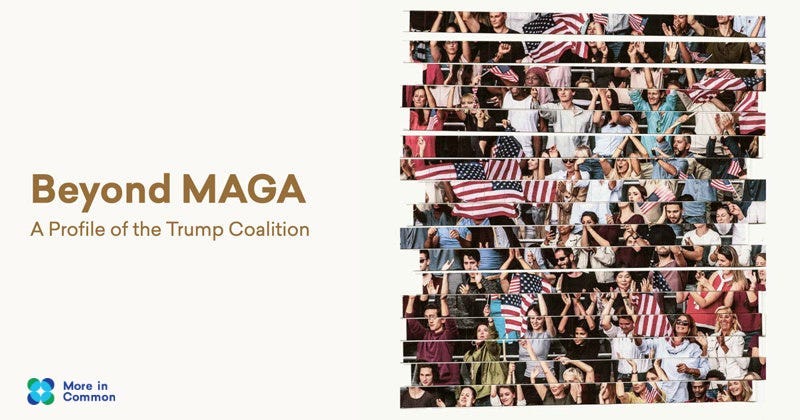
While there are deep distinctions between the most ardent Trump supporters and the Reluctant Right, one position shared across all four types of Trump voters is an aversion to wokeness. When asked how serious a problem wokeness is, Trump voters ranked it at 79 out of 100. Even the Reluctant Right ranked it at 71. Similarly, when asked whether “The woke left has ruined American education, news, and entertainment,” 76% of 2024 Trump voters agreed. That includes 58% of the Reluctant Right.
II. The Math Is Unforgiving
The Reluctant Right represents roughly 20% of Trump’s 2024 coalition. That’s 20% of over 77 million voters. That’s not a rounding error. That’s more than 15 million of our friends and neighbors. In a country where elections are decided by margins that can be measured in hundreds of votes, that’s the ballgame.
Consider this: the U.S. House district where I live was decided by 333 votes out of nearly 350,000 cast. That’s one tenth of one percent. That margin put a representative in office who voted to overturn the certified election results of Pennsylvania and Arizona. Three hundred and thirty-three people. In one congressional district.
Swing states have been and will continue to be decided by margins nearly as thin. Which means that those who long for civic renewal – and believe that defeating Trumpism is key to that – face a real choice. We must decide what matters more: demanding conformity, canceling the insufficiently orthodox, insisting on an inventory of each person’s “privilege” at every gathering, and requiring that anyone who ever pulled a lever for Trump first take a flagellum to themselves before being welcomed in polite company? Or doing the actual work of winning?
The evidence suggests the answer. In Virginia and New Jersey, the candidates who won governorships in off-year elections weren’t running on the agenda of the activist left. Abigail Spanberger and Mikie Sherrill ran on affordability, kitchen-table issues that speak directly to the concerns of voters in the Reluctant Right. They won. By large margins. The lesson is available to anyone willing to read it.
If you have accumulated so much contempt for anyone who’s ever voted for Trump that you’d rather nurse your malice than make room in the coalition for people who are genuinely persuadable, understand this: you are part of the problem. Like the finger-waggers who radicalized my friend in the first place.
But for everyone else, there’s a different path. What the pro-democracy coalition needs to do is akin to what William F. Buckley did with the Birchers: Marginalize the voices whose behavior is illiberal, arguably unethical, and makes the coalition unelectable. Don’t let the most performatively aggrieved define what the movement is. And when someone from the Reluctant Right shows up at the party, we can simply say: come on in. The water’s warm.
III. What Loyalty Actually Costs
Such an invitation only means something if we’re honest about what’s being left behind. Because the same question, at what cost, has been asked and answered by people on the other side of this divide. Asked and answered in public, in full, with the receipts available for anyone who wants to look.
Is Pam Bondi proud of the burn book she prepared for that congressional hearing? Did she call her mother and beam about how she ignored the victims of sexual abuse and sex trafficking? “Hey Mom, look. No morals.” What about Bill Barr, who ultimately stood in the breach during those brittle days between the 2020 election and the inauguration, but only after spinning the Mueller report to the point of propagandistic weaponry? Does he consider that bargain well made? And Marco Rubio, who in 2016 warned with startling clarity about exactly the kind of figure Trump was, and who now sits in his cabinet. What was his inner monologue on that Oval Office couch as the similarly morally compromised J.D. Vance attacked and demeaned a genuine hero of democracy, Volodymyr Zelensky?
These aren’t rhetorical questions. They’re the same question we started with, applied to people who had everything to lose and chose to lose it anyway. At what cost?
IV. The Question Comes Home
The question doesn’t stay on only one side of the aisle. Those of us who care about civic renewal – those who are registered Democrats as well as the growing number of us who are independents – have had our own “at what cost” moments, and how we answer them will determine whether we deserve to win.
Take Proposition 50 here in California or a similar amendment that was just passed in Virginia. Independent redistricting commissions have been one of the healthiest renovations to our democratic process in half a century, perhaps more. The argument for dismantling them, even temporarily, goes something like this: Republicans have gerrymandered ruthlessly, so Democrats should gerrymander back in self-defense, just this once, until the threat passes. But the time to commit to one’s principles is precisely when it’s hard. Compromising them “just this once” is a little like telling your spouse you’re going to have an affair: “...but only this once, because, you know, I’m really mad at you. And, uh, she’s so hot…” The logic doesn’t hold. And the precedent it sets is worse than the problem it claims to solve.
Many people I engage with are under the impression that my agenda is to elect Democrats. They’re wrong. My agenda is to repair what’s broken in our democracy. Civic renewal. In the age of Trump, that often involves supporting candidates who are either in the Democratic party or have exhibited the independence to remain true to actual conservative or classical liberal principles. And yes, that means being in opposition to Trump most of the time. But opposition to Trump isn’t merely reflexive. It’s rooted in what he’s done and said that stands in direct opposition to what I believe: Judeo-Christian values, the constitutional order, and a basic sense of decency. To look upon his words and actions and view any of it as faithful to the American Founders’ vision would be the real Trump Derangement Syndrome.
To those who are more like my friend, whose animating motivation is to stick it to the scolds who want to police what everyone says, determine what all our children must learn, dictate what symbols our stores must display, and manipulate the news we’re able to consume: I understand the impulse. But I return to the question we started with. At what cost?
V. Closing
Over the course of the last year, there have been a number of high-profile public figures who seem to be asking themselves that very question. Joe Rogan, love him or hate him, hosts the most popular podcast in the world. His endorsement of Trump in 2024 garnered significant attention. And yet, within months, Rogan was publicly criticizing the administration on multiple fronts: immigration tactics, the Epstein files, the war in Iran. Whatever you think of his specific complaints, the willingness to break from someone he’d just championed is the point.
We can look back at an ever-growing list of prominent defections from the MAGA movement: the VP under the first administration, Mike Pence; Trump’s former chief of staff, General John Kelly; the former chair of the House Republicans, Liz Cheney; and so many others. Every day there are others who wrestle with the basic question we’re dealing with here. Is continued support of Donald Trump worth what it’s costing us as a country and on an individual level? Is it all worth paying such a price in order to go on owning the libs?
Each time a friend or relative of mine comes to the conclusion that it’s not, I say good. That’s it. I’m not inclined to make them confess their sins, say a bunch of Hail Marys and Our Fathers, or anything of the sort. I might invite them out for lunch or a drink and just enjoy their company. But I’d rather just appreciate the fact that someone’s evolved on certain positions. Or maybe a better way to put it is that I’d rather work on being able to truly see my friend and deeply hear my loved one, rather than continue holding on to my own grievance to the point where I can’t see the humanity in someone else.
Taking consistently moral positions is hard, especially when your adversary is amoral & transactional. In the short run, principled people suffer a great disadvantage because we honor boundaries, norms & ethical standards while our amoral transactional adversaries aren't limited by moral considerations. But in the long run, abandoning morality is a losing proposition for everyone. The once principled people lose their legitimacy & credibility & the entire society loses its soul.
That is what is happening today to America, both domestically & internationally.
The MAGA GOP destroyed the moral core of the Republican Party & Democrats quickly abandoned its moral core as well. Internationally, America has devolved from the shining city on the hill we once were into a rogue state bullying its way, albeit somewhat unsuccessfully, around the world.
Excellent points all Corey (as usual). I’d like to offer a few more for consideration:
A major contributing factor to the division and anger is the use of pejorative and often vague terms which dehumanize the “other.” Labels. There is too much political and journalistic shorthand — red and blue states, libs, woke, radicals, antifa, socialists, etc. Even MAGA or MAHA. Those labels reduce understanding and increase division (and violence).
For example, while I understand the intent, calling a state — or city or town — red or blue is both inaccurate and misleading. There are plenty of Democrats in “red” localities as well as Independents and people with no political party affiliation. Same with Republicans, Independents, and non-affiliated persons in “blue” localities. There are so-called red states with “blue” elected officials as well, and vice versa. Republican governors with state legislatures that are majority Republican, or split. Are those states accurately described as “red?’
I also take issue with the “More In Common US” study when it poses questions about “wokeness.” What does that term mean — not by dictionary definition, but by the various meanings held by survey respondents? Ask 100 people what “woke” means to them and you’re likely to get many dozens of different responses. So, how can we have an educated and honest discussion when the participants can’t agree on the terms used. I’d argue its much easier to hate, disparage, or disagree with someone marked by a vague label, especially in response to a question and not in direct dialogue with that other person.
Perhaps we could communicate better, and more humanely, if we eschewed labels and vague shorthand terms.