Stolen Ground
Why I stopped saying the Pledge. And why I started again.

When we were kids, in public school, every morning we’d all stand, put our hands on our hearts and say the Pledge of Allegiance. It was all pretty rote. Mechanical even. I never really gave it much thought.
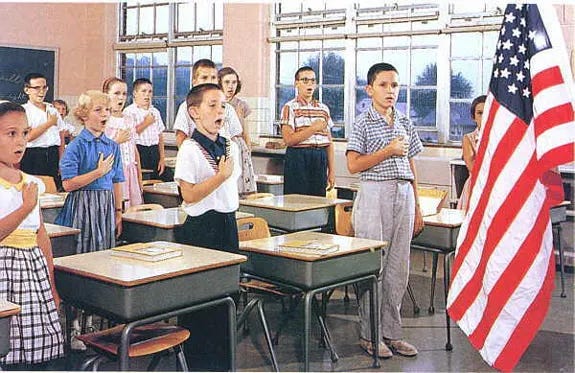
About 15 years ago, I joined a local business group that started their meetings the same way. I got up, mostly out of muscle memory, but before I put my hand on my heart, I was startled into an awkward awareness. “Wait, what are we doing here?” I thought to myself. It was the first time in my adult life that I was in an organized gathering that shoehorned that particular ritual into their agenda every week.
I mean, I’d been to plenty of sporting events where they play the Star Spangled Banner before the game. And yes, I’d stand and remove my cap if I wasn’t out getting a last minute snack. But for some reason, the actual Pledge: the hand on the heart and the saying out loud just caught me off guard.
So that week, I put some thought to it. Is this a pledge I can make? It is, after all, a pledge. Is this a ritual I choose to participate in? Because, make no mistake, it is a ritual.
It just so happened that during the week in between my first and second meeting with this group, I was reading through the Book of Daniel. In Chapter 3, it recounts the story of Nebuchadnezzar having a huge golden statue of himself built and requiring all officials to bow down to it when certain music plays. But Daniel and his pals Shadrach, Meshach, and Abednego can’t participate out of deference to Command number 1: Thou shalt have no other gods before me.
Call me superstitious; but I admit that I took it as a sign. At the very least, re-reading that passage was instructive.
What were we doing participating in this collective act of worship? It’s a flag. We’re pledging allegiance to a flag. And even in 2011, as I guess has been happening for many, many years, the American flag had become, for many, more than a symbol. Indeed, it’s become something of an idol.
Then, attending that second meeting helped to seal the deal for me. The way the Pledge is chanted — in particular, the unwritten pauses that make their way into every recitation — cemented my conviction to opt out. Specifically, what I decided to do was stand and face in the direction of the flag without putting my hand on my heart or saying the words. In my figuring, that was the way to balance being respectful to everyone else in the room, not drawing attention to myself (because the point wasn’t to make a statement), while being true to my own beliefs.
So it might sound surprising, if not flat-out hypocritical to share that in recent months, I decided to start saying the Pledge.
Why, one might ask, would someone start pledging the flag after 15 years of refusing to do so? Perhaps someone finally badgered him enough that he relented. Perhaps he wanted to curry favor with the other people in the room. Perhaps it was a cynical business calculation.
Short answer: No. No. And no.
Yes, I have been badgered on and off about it for the last decade and a half. But I’ve never found the badgering to be persuasive — whether it be of the lighthearted sort or that which had a bullying tinge. In terms of currying favor or calculating potential profits, that train left the station approximately 14 years and 11 months ago. The folks in the room who took offense to the placement of my hand and the silence of my voice at that point in our weekly meetings wrote me off long before this moment.
The thing is, it’s been on my mind over the last year or so. Since approximately November 5th, 2024. Since it became official that there were enough voters in this country for whom January 6th, 2021 wasn’t disqualifying. Since the election of an individual who makes a mockery of such a virtue as “allegiance” and has no regard for what this Republic truly stands for.
Part of what finally settled it was reading the actual words of the Pledge. When I did, my 7th grade English teacher’s voice was almost screaming inside my head: “No commas. Do you see any commas there? No! Why are we pausing where there are no commas?!?!” As if punctuation, or the lack thereof, was as revelatory as a lightning strike. (And now I’m also hearing Steve Martin’s voice from Planes, Trains and Automobiles yelling, “Those aren’t pillows!”)
But when I took time to read the Pledge, it somehow occurred to me, in a way it hadn’t hit me before, that the pledge wasn’t necessarily to a flag, but to this Republic for which it stands. A republic that accounts for our worst impulses and somehow incentivizes our better angels. That enshrines unalienable rights while leaving room for a more perfect union. That has, against considerable odds, held together. And I realized: that’s a pledge I can make.
Consider, for a moment, what was on display on January 6th. Men with the American flag draped across their backs like a cape, the pole it flew on literally weaponized to gouge police officers on the steps of the United States Capitol. That image isn’t a generalization. It isn’t an abstraction. It’s a photograph. Many photographs. Specific people. A specific act. A specific desecration.
That’s what it looks like when the flag belongs to you and the Republic doesn’t.
So no. I’m not ceding that ground. Not the flag. Not the Pledge. Not “conservative.” Not “evangelical.” Not “Christian.” Not “liberty.” Not “freedom.” So many of these words have been sloganized, shouted with the same intent as the ones wielding flagpoles as lances. These words and these symbols belong to the tradition, not to the people who’ve hijacked them. Saying the Pledge now isn’t capitulation. It’s repossession.
Jump cut to Spring morning, 2026. Santa Clarita Valley Business Group:
Hand on heart. Slightly out of rhythm with everyone else in the room. Because I’m saying it to myself, for myself, without the unwritten pauses. Without those hypnotic pauses. Just the words, at the speed they were meant.
I pledge allegiance to the Flag of the United States of America and to the Republic for which it stands, one nation under God indivisible with liberty and justice for all.
No artificial commas. My 7th grade English teacher would finally be satisfied.
And you know what’s funny? Not a single person in that room has said a word about it.
In the late 1960s, when protests to the Vietnam War exploded, the flag became a symbol in support of that war & it took decades for me to regain the sense that this was my flag too. When patriotism becomes conflated with support for the present government, loyalty to America gets corrupted into allegiance to a partucular ideology, a aparticualr person or group of people, and I want no part of that. THAT is the exact opposite of patriotism.
I’ve always assumed that the pauses make it easier to remember the words. It has also occurred to me that the pauses nudge us to remove the meaning from what the words say when strung together. The same is true with the Presidential oath, the oath we take before testifying in court, and singing the star spangled banner.
I can remember memorizing both the pledge and the national anthem as a kid in school and never thinking about or recognizing what either one meant until we learned about it, maybe in second or third grade and then forgetting those meanings just as quickly shortly after. Both the pledge and the anthem are about reverence to the flag, which of course then complicates things when we have to discuss whether flag burning is acceptable speech or not.
It also complicates things regarding religion. The pledge mentions a god, as does all of our currency and oaths in court and of office include the hand on the bible routine. Both the mention of a God in the pledge and on our currency were added after they were originally codified. As for swearing in, while a Christian Bible isn’t specified, many Americans seem to object to somebody outside the Christian-Judeo tradition using a bible more meaningful to them when taking an oath.
Personally, I think this has lead to a mass misunderstanding of what this nations is, should be, and was intended to be by the people who founded it.